The Data Diva Talks Privacy Podcast
Debbie Reynolds “The Data Diva” talks Data Privacy with industry leaders around the world about issues businesses need to know now.
Join me weekly for new episodes
““I want to tip my hat to you ...the leadership that you’ve shown, as well as the platform that you’ve created, is simply amazing.””
“If anybody knows where to go for the types of conversations that they need to have on Data Privacy, you are that person. You are a rock star in this space.” ”
#1 Data Privacy Podcast Worldwide (Privacy Plan)
5 Best Data Privacy and Data Protection Podcasts for 2025 (Velotix)
Best Data Privacy Podcasts 2026 (RadarFirst)
The 17 Best Privacy Podcasts To Listen 2025 (bCast)
Best Data Privacy Podcasts 2025 ( Player FM)
Best Data Privacy Podcasts 2026 (Goodpods)
Best Privacy Podcasts 2026 (Feedspot)
The 10 Best Data Privacy Podcasts In The Digital Space 2024 (bCast)
Best Data Privacy Podcasts 2024 (Player FM)
Best Data Privacy Podcasts Top Shows of 2024 (Goodpods)
Best Privacy and Data Protection Podcasts of 2024 (Termageddon)
Top 40 Data Security Podcasts You Must Follow 2024 (Feedspot)
Top 50 in Business and Management 2024 (Apple Podcasts)
Top 25% in weekly Downloads 2024 (The Podcast Host)
Top 2% of 3 million + globally ranked podcasts of 2024 (ListenNotes)
12 Best Privacy Podcasts for 2023 (RadarFirst)14 Best Privacy Podcasts To Listen To In This Digital Age (bCast) in 2023
Best Data Privacy Podcasts 2022 (Player FM)
10 Best Top 10 Data Privacy Podcasts by DataTechvibe in 2022
20 Best Data Rights Podcasts of 2021 (Threat Technology Magazine)
20 Best European Law Podcasts of 2021 (Welp Magazine)
20 Best Data Privacy Rights & Data Protection Podcast of 2021 (Welp Magazine)
20 Best Data Breach Podcasts of 2021 (Threat Technology Magazine)
Top 5 Best Privacy Podcasts 2021 (Podchaser)
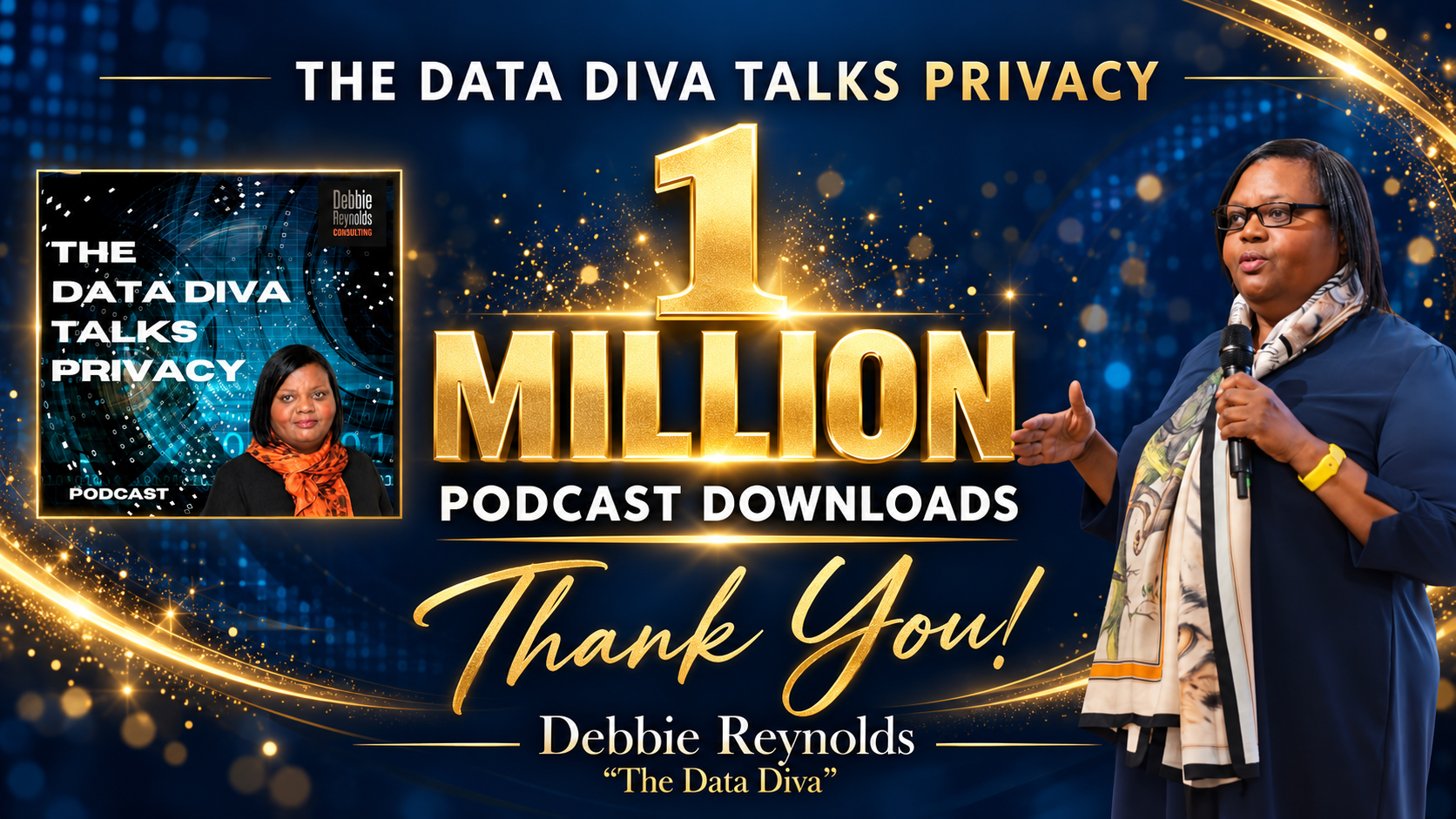
"The Data Diva" Talks Privacy Podcast reaches listeners in over 157 countries with over 1 million+ downloads!
〰️
"The Data Diva" Talks Privacy Podcast reaches listeners in over 157 countries with over 1 million+ downloads! 〰️
💃🏾 Search All Data Diva Talks Privacy Podcast Full-Episode Transcripts
Type a topic, guest name, or keyword to find matching episodes. This tool searches all public transcript pages.
Powered by Google Programmable Search. No login required.
💬 ChatGPT Chatbot: Search The Data Diva Talks Privacy Podcast Transcripts
Use this AI-powered tool to search over 250 full-episode transcripts from Debbie Reynolds' podcast. Get links and summaries of the most relevant episodes.
Free to use. Requires a free ChatGPT account.
🔍 Start ChatGPT Search
Debbie Reynolds, The Data Diva, Talks with Tom Kemp of Cal Privacy on Privacy Advocacy
In this introduction from The Data Diva Talks Privacy Podcast, Debbie Reynolds, “The Data Diva,” speaks with Tom Kemp, Executive Director of Cal Privacy, the California Privacy Protection Agency (CPPA), about their professional relationship and shared work in privacy advocacy and public policy. Episode 277 was released February 24, 2026..

E311 - Rupal Dadu Patel, Director of Enterprise Data & Analytics
E311 – Rupal Dadu Patel, Director of Enterprise Data and Analytics
In this episode of The Data Diva Talks Privacy, Debbie Reynolds, the Data Diva speaks with Rupal Dadu Patel, Director of Enterprise Data and Analytics, about why strong data foundations remain essential as organizations race to adopt AI. Drawing on more than 20 years of experience in data management, Rupal explains why technology cannot compensate for poor data quality, unclear business context, weak governance, or a lack of understanding about how information should be used.
Debbie and Rupal explore “data rot,” data lifecycle management, knowledge management, data products, privacy by design, and why organizations need to understand what data they have, where it came from, who should have access to it, and what purposes it can support. They also discuss AI readiness and the importance of building privacy and data ethics into the foundation of an organization rather than treating them solely as regulatory requirements.
The conversation takes a deeper look at AI agents and agentic workflows, including an emerging access-management challenge: AI systems may inherit privileges from the humans who create or operate them. Debbie and Rupal discuss why organizations need new ways to govern AI access, assess AI use cases and data inputs, continuously educate employees, and establish the organizational foundations necessary to use AI responsibly.

E310 - Shubh Sinha, CEO, Integral Privacy Technologies
E310 – Shubh Sinha, CEO, Integral Privacy Technologies
Show Notes
In this episode of The Data Diva Talks Privacy, Debbie Reynolds, the Data Diva speaks with Shubh Sinha, CEO of Integral, about the growing importance of private and proprietary data in AI, de-identification, data quality, and why privacy should be built into data use from the beginning rather than addressed at the end.
Drawing on his experience building analytics environments using highly sensitive and regulated data, Shubh explains how Integral evolved from healthcare de-identification to what the company describes as an independent privacy layer for AI. Debbie and Shubh discuss the challenge of preserving valuable signals in data while meeting regulatory and contractual obligations, the increasing risks created when organizations combine data sets, and why data lineage becomes more complicated as data moves between organizations and systems.
The conversation also explores how the AI era is changing the value of enterprise data. As AI models become more capable, organizations increasingly want to use proprietary information to generate better insights and business outcomes. Debbie and Shubh discuss why data quality, purpose, privacy, and governance become even more important in that environment and why proactive privacy can help organizations innovate more effectively.

E309 - Julian Gage, Founder, Engage Compliance
E309 – Julian Gage, Founder, Engage Compliance
Show Notes
In this episode of The Data Diva Talks Privacy, Debbie Reynolds, the Data Diva speaks with Julian Gage, Founder of Engage Compliance, about the EU AI Act, evolving privacy requirements, DPO services, audits and assessments, and the expanding role of privacy professionals in AI governance.
Based in Amsterdam and working with organizations across Europe and the United States, Julian brings a background in cybersecurity, auditing, privacy, and data protection to the conversation. He and Debbie discuss how organizations can approach compliance more practically by understanding their actual operations, identifying risk, building trust with stakeholders, and treating audits and assessments as tools for improvement rather than exercises in fear.
The conversation takes a deeper look at the EU AI Act, which Julian identifies as the leading concern he is hearing from clients. Debbie and Julian discuss how organizations can determine which requirements actually apply to their AI use, how existing GDPR and privacy practices can provide a foundation for AI compliance, the importance of AI literacy, and why customer expectations may push companies toward compliance even before regulatory deadlines require it. They also explore why privacy professionals are increasingly being asked to help organizations navigate AI regulation and the opportunities this creates for the future of the profession.

E308 - Monique Priestley, Vermont State Representative
Monique Priestley, Vermont State Representative
In this episode of “The Data Diva” Talks Privacy, Debbie Reynolds, “The Data Diva” speaks with Monique Priestley, Vermont State Representative, in a return appearance about what happens behind the scenes when lawmakers work to strengthen privacy and consumer protection. Building on their earlier discussion of Vermont H.121, Monique explains how the state’s privacy efforts evolved into separate initiatives involving children’s protections, data brokers, and comprehensive consumer privacy legislation.
The conversation offers a candid look at legislative negotiations, industry lobbying, expert testimony, political pressure, and the compromises that can shape the final language of privacy legislation. Debbie and Monique also discuss the importance of independent expertise, public education, and understanding the substance of a bill, including its definitions, exemptions, enforcement provisions, and consumer protections, rather than relying only on whether it passed or failed.

E307 - Dr. Moya Hill, CEO and Founder, Dr. Moya Hill Solutions
Dr. Moya Hill, CEO and Founder, Dr. Moya Hill Solutions
In this episode of “The Data Diva” Talks Privacy, Debbie Reynolds, “The Data Diva” speaks with Dr. Moya Hill, CEO and Founder, Dr. Moya Hill Solutions, about information governance as a foundation for privacy, records management, cybersecurity, risk, transparency, and AI. Drawing on her federal government experience across FOIA, records, and privacy, Dr. Hill explains why functions that are often managed separately are ultimately working with the same organizational information and benefit from a more coordinated approach.
Debbie and Dr. Hill discuss the cost of organizational silos, the risks of introducing AI into environments where information is poorly structured or secured, and why governance requires more than policies. The episode explores how retention, access, risk, transparency, and other information-governance principles can help organizations better understand their information and strengthen their readiness for AI.

E306 - Jamal Ahmed, CEO of Kazient Privacy and AI Experts, and Privacy Pros Academy
Jamal Ahmed, CEO of Kazient Privacy and AI Experts, and Privacy Pros Academy
In this episode of “The Data Diva” Talks Privacy, Debbie Reynolds, “The Data Diva” speaks with Jamal Ahmed, CEO of Kazient Privacy and AI Experts, and Privacy Pros Academy, about the expanding opportunities for privacy professionals in AI governance. A returning guest, Jamal explains why many skills privacy professionals already use, including data mapping, assessments, regulatory interpretation, governance, risk management, and training, translate naturally into AI governance work.
The conversation also explores AI literacy, the EU AI Act, and Jamal’s book The Easy Peasy Guide to the EU AI Act, for which Debbie wrote the foreword. Debbie and Jamal discuss why organizations increasingly need professionals who can understand AI, translate regulation into practical business processes, and help companies build trust and demonstrate responsible governance as AI adoption accelerates.

E305 - Emma Day, Co-CEO Tech Legality | Human Rights & AI Governance Lawyer
Emma Day, Co-CEO, Tech Legality | Human Rights & AI Governance Lawyer
In this episode of “The Data Diva” Talks Privacy, Debbie Reynolds, “The Data Diva” speaks with Emma Day, Co-CEO of Tech Legality and Human Rights & AI Governance Lawyer, about privacy as a fundamental human-rights issue and the growing risks surrounding children’s data. Emma shares how her experience teaching in Rwanda shaped her understanding of the profound consequences personal information can have for safety, equality, opportunity, and justice.
The conversation explores children’s privacy, EdTech, neurotechnology, AI companions, and the uneven protections children experience around the world. Debbie and Emma also discuss the responsibilities of regulators and technology companies, the importance of human-rights and data-protection impact assessments, and why organizations should consider the human consequences of technology alongside innovation and business objectives.

E304 - Damnjan Jovanovic, Tech Educator, Explaining Privacy Tech to Lawyers and DPOs
Damnjan Jovanovic, Tech Educator, Explaining Privacy Tech to Lawyers and DPOs
In this episode of “The Data Diva” Talks Privacy, Debbie Reynolds, “The Data Diva” speaks with Damnjan Jovanovic, Tech Educator, Explaining Privacy Tech to Lawyers and DPOs, about why privacy professionals benefit from understanding the technology behind the terminology. Drawing on more than 20 years as a developer and his experience as an educator, Damnjan explains how he helps lawyers, DPOs, and other nontechnical professionals connect familiar privacy concepts with what is actually happening inside browsers, applications, and digital systems.
The conversation explores cookies, browser fingerprinting, AI, wearable cameras and smart glasses, and the importance of understanding both how technologies work and how they are used. Debbie and Damnjan also discuss the limits of notices and cookie banners, the privacy implications of information shared with AI systems, and why stronger technology literacy can help professionals and the public make more informed decisions in an increasingly complex digital environment.

E303 - Rob Tiffany, Research Director, IDC, and Author of Saving The Earth with The Internet of Things
Rob Tiffany, Research Director, IDC and Author of Saving the Earth with the Internet of Things
In episode 303 of The Data Diva Talks Privacy, Debbie Reynolds, The Data Diva speaks with Rob Tiffany, Research Director at IDC and author of Saving the Earth with the Internet of Things, about the evolution of the Internet of Things, sustainability, privacy, and the practical use of connected technologies to solve real-world problems. Rob shares his early work developing connected vending machines during the 1990s, before cloud platforms and modern wireless infrastructure made IoT development easier.
The conversation explores how connected vending machines were used to monitor inventory, optimize delivery routes, identify purchasing patterns, and forecast profitability. Rob explains how his team built much of the necessary hardware, software, wireless connectivity, and digital models from scratch. He also shares an unexpected lesson about transparency when some vending operators were less interested in technology that revealed how much money their machines generated.
Debbie and Rob discuss how IoT can help cities and buildings become more sustainable by identifying water leaks, reducing unnecessary energy consumption, monitoring occupancy, and improving the management of lighting and heating systems. They also examine the privacy risks created when sensors, cameras, connected devices, and smart infrastructure collect information about people’s movements, behaviors, and daily routines.
The episode highlights Rob’s book, Saving the Earth with the Internet of Things, and its connection to the United Nations Sustainable Development Goals. Rob discusses precision agriculture, soil moisture sensors, automated irrigation, crop yields, fertilizer use, food storage, and cold-chain monitoring. These technologies can help farmers conserve water, reduce waste, protect food supplies, and produce more food for a growing global population.
The conversation also addresses data minimization, security, and the responsibility organizations assume when collecting information. Debbie and Rob discuss why companies should carefully consider whether information needs to be collected or retained, particularly when a breach can expose personal or financial data permanently. The episode concludes with Rob’s belief that IoT can help address major global challenges while acknowledging that
protecting connected systems and the data they generate will remain an ongoing responsibility.

E302 - Drs. Andor Demarteau, Founder and Owner, Shamrock Information Security
Debbie Andor Demarteau, Founder and Owner, Shamrock Information Security
In this episode of The Data Diva Talks Privacy, Debbie Reynolds, The Data Diva speaks with Andor Demarteau, Founder and Owner of Shamrock Information Security, about European data protection, information security, artificial intelligence, encryption, and the growing tension between innovation and fundamental rights. Andor shares his professional background and discusses the history of European privacy protections, from early human rights frameworks and Convention 108 to the GDPR and the expanding collection of European technology laws.
The conversation explores the difference between passing regulations and enforcing them effectively. Andor explains why large financial penalties may become little more than a cost of doing business for major technology companies. Debbie and Andor discuss how enforcement that directly affects a company’s operating model can create more meaningful change than fines alone.
The episode examines the data hunger of artificial intelligence systems and the risks created when models ingest large volumes of information from businesses, artists, employees, and individuals. Debbie and Andor discuss data scraping, model manipulation, prompt injection, hidden instructions placed within documents, and the importance of protecting organizational information from systems actively searching for accessible data.
Debbie and Andor also examine the differences between the GDPR and the EU AI Act. They discuss the EU AI Act’s risk-based approach, its focus on potential harm, and the confusion created as portions of the law take effect while European policymakers simultaneously consider efforts to simplify or change technology regulation. The conversation highlights risks associated with AI use in recruitment, emotional monitoring, surveillance, and automated decision-making.
The discussion also addresses proposals to weaken encryption, connect online activity to government identity, and introduce systems that could eliminate meaningful anonymity. Andor explains why universal access keys create security risks and why encryption remains essential to online communication and digital safety. The episode concludes with a discussion of human behavior, data minimization, secure software development, and why collecting less information remains one of the strongest ways to reduce privacy and security risk.

E301 - Naureen Hussain, Founder, Luminate Advisers Limited (United Kingdom)
Naureen Hussain, Founder, Luminate Advisers Limited (United Kingdom)
In this episode of The Data Diva Talks Privacy, Debbie Reynolds, “The Data Diva,” speaks with Naureen Hussain, Founder of Luminate Advisers Limited in the United Kingdom, about the evolving role of privacy leaders, digital transformation, AI governance, and the importance of moving from gatekeeper to coach. Naureen shares her career journey from employment law into privacy, data protection, and digital transformation, explaining how curiosity and a willingness to raise her hand created new opportunities throughout her career.
The conversation explores how privacy professionals can become more effective by helping business teams understand how to achieve responsible outcomes rather than simply explaining legal requirements. Naureen discusses the importance of building trust, developing relationships, and helping stakeholders evaluate practical options and trade-offs.
Debbie and Naureen examine the growing pressure on privacy teams as organizations accelerate digital initiatives and AI adoption. They discuss why privacy, data governance, security, architecture, legal, ethics, and business strategy can no longer operate in isolation and why privacy leaders must build strong networks across the organization.
Naureen introduces the idea of moving from parent-child workplace dynamics toward adult-to-adult conversations. She explains that privacy leaders should clearly present risks, benefits, and consequences while allowing accountable business leaders to own the final decision. The discussion also highlights the need for risk-based approaches, clear guardrails, and practical escalation processes.
The conversation concludes with a discussion of human agency, human rights, workforce transformation, and the role privacy professionals can play in responsible AI adoption. Naureen encourages privacy leaders to move beyond box-ticking, reconnect privacy to its human impact, and engage earlier with business, technology, and Human Resources leaders.

E300 - Cat Casey, Founder, The Technocat, Chief Legal AI Futurist, Masters AI
In this episode of The Data Diva Talks Privacy, Debbie Reynolds, “The Data Diva,” speaks with Cat Casey, Founder of The Techno Cat and Chief Legal AI Futurist at Masters AI, about the transformation of the legal profession, AI literacy, and the governance challenges created by increasingly autonomous AI systems. Cat shares her unconventional journey from philosophy into legal technology and explains how her work has focused on helping legal professionals understand complex technologies in practical, accessible ways.
The conversation explores why AI literacy is becoming an essential professional responsibility for lawyers. Cat explains that legal professionals must understand how AI tools work, where they may fail, and how they affect confidentiality, competence, supervision, and accountability. Debbie and Cat discuss how lawyers remain responsible for verifying anything they sign, submit, or rely upon, regardless of whether AI helped produce it.
The episode examines the rise of AI agents and why organizations need stronger controls as systems gain the ability to access data, make decisions, and take actions on behalf of users. Debbie and Cat discuss examples involving an AI agent deleting emails and a chatbot making a promise that created consequences for the company. These examples highlight the need for clear permissions, access controls, human intervention, and accountability.
Debbie and Cat also discuss hallucinated legal cases, inaccurate quotations, automation bias, and the risks of outsourcing professional judgment to technology. Cat emphasizes that lawyers must continue reading cases, checking citations, and verifying legal authority, even as AI tools become more sophisticated.
The conversation concludes with a discussion of why privacy professionals should be involved much earlier when organizations evaluate and implement new technologies. Cat explains that privacy, security, ethics, and governance must be considered together if organizations want to adopt AI responsibly.

E299 - Keith Weisman, Head of Forward Deployed Engineering, Jetstream Security
Keith Weisman, Head of Forward Deployed Engineering, Jetstream Security
In this episode of The Data Diva Talks Privacy, Debbie Reynolds, The Data Diva speaks with Keith Weisman, Head of Forward Deployed Engineering at Jetstream Security, about AI governance, security, visibility, and the growing challenges organizations face as artificial intelligence becomes deeply integrated into business operations. Keith shares his engineering and security background and explains how organizations are increasingly struggling to understand where AI is being used, how it accesses data, and what governance controls are necessary to support safe and responsible adoption.
The conversation explores how AI is rapidly becoming embedded throughout organizations, often faster than governance programs can keep pace. Debbie and Keith discuss the growing problem of shadow AI, where employees adopt AI tools outside approved processes and oversight structures. They examine why organizations need greater visibility into AI usage, including what tools are being used, who is using them, what data is being shared, and how AI systems interact with business processes and sensitive information.
Keith introduces Jetstream Security's framework for addressing what he describes as five critical AI trust gaps: visibility, design control, continuous monitoring and drift management, agentic identity, and trust enforcement. He explains that organizations must first understand where AI is being used and how it operates before they can effectively govern it. The framework emphasizes the importance of understanding AI system design, monitoring for changes and unexpected behavior over time, establishing accountability for AI actions, and creating safeguards that maintain trust as AI capabilities continue to evolve.
The episode also explores the rise of AI agents and non-human identities. Keith explains that organizations have traditionally managed identities for people, applications, and devices, but AI introduces a new category of actors capable of making decisions, interacting with systems, and performing tasks autonomously. Debbie and Keith discuss why AI agents require the same level of oversight, permissions management, monitoring, and accountability that organizations already apply to human users and other privileged identities.
Throughout the conversation, Keith shares real-world examples illustrating the risks associated with AI systems that are granted excessive access or insufficient oversight. These examples include AI systems making unauthorized changes, interacting with systems in unexpected ways, and performing actions that organizations did not anticipate. The discussion highlights the importance of applying established governance principles such as least-privilege access, monitoring, accountability, and risk management to AI-enabled environments.
Debbie and Keith also discuss the relationship between innovation and governance, emphasizing that governance should not be viewed as a barrier to innovation. Instead, effective governance provides the foundation organizations need to deploy AI responsibly and at scale. As AI systems become increasingly integrated into business operations, organizations must develop new approaches to visibility, accountability, identity management, and trust that address both human and non-human actors operating within complex digital ecosystems.
The conversation concludes with a discussion of the future of AI governance and the importance of creating frameworks that allow organizations to benefit from AI while maintaining security, privacy, compliance, and trust. Keith emphasizes that organizations that invest in visibility, accountability, and governance today will be better positioned to manage risk and realize the long-term benefits of AI adoption.

E298 - Laura Pleskatcheva, Data Privacy and AI Governance Operations
Laura Pleskatcheva, Data Privacy and AI Governance Operations
In this episode of The Data Diva Talks Privacy, Debbie Reynolds, The Data Diva speaks with Laura Pleskatcheva, a Data Privacy and AI Governance Operations professional, about the critical role privacy operations plays in helping organizations translate regulatory requirements into practical business processes. Laura shares her career journey from corporate finance into privacy, explaining how her interests in business operations, technology, compliance, and cross-functional collaboration led her to a career in privacy and AI governance.
The conversation explores the common misconception that privacy is solely a legal or compliance function. Laura explains that while legal teams focus on understanding requirements and obligations, privacy operations is responsible for implementing those requirements in a way that works across the organization. Debbie and Laura discuss the distinction between the "what" and the "how," highlighting how privacy operations serves as the bridge between policy and execution.
The episode examines the practical work involved in operationalizing privacy programs, including project management, relationship building, stakeholder engagement, and cross-functional collaboration. Laura explains that privacy professionals frequently work across legal, marketing, HR, technology, security, and business teams to ensure that privacy requirements are effectively implemented. The discussion highlights why communication, influence, and collaboration are often just as important as technical or legal knowledge.
Debbie and Laura also explore the importance of organizational culture and leadership support in building successful privacy programs. Laura emphasizes that privacy is a team sport and that executive engagement is often the key factor that determines whether privacy initiatives succeed. When leadership understands privacy risks and values trust and integrity, organizations are better positioned to integrate privacy into everyday business practices.
The conversation also addresses the rapid pace of technological change and the growing attention organizations are placing on artificial intelligence. Laura explains that while AI has become a major focus for businesses, privacy requirements and obligations have not disappeared. Organizations must continue managing privacy compliance while simultaneously developing governance frameworks for AI technologies. The discussion highlights the need for organizations to understand how personal data is used within AI systems and to educate both employees and consumers about the risks and benefits associated with emerging technologies.
The episode concludes with a discussion of third-party risk management and vendor accountability. Debbie and Laura examine the challenges organizations face when working with vendors that process personal data and discuss the importance of contracts, audits, due diligence, trust, and ongoing oversight. As organizations become increasingly interconnected through technology platforms and outsourced services, strong vendor governance practices remain a critical component of privacy and AI governance programs.

E297 - Patrick Zeller, General Counsel, Jetstream Security
Patrick Zeller, General Counsel, Jetstream Security
In this episode of The Data Diva Talks Privacy, Debbie Reynolds, The Data Diva speaks with Patrick Zeller, General Counsel of Jetstream Security, about artificial intelligence, cybersecurity, privacy, and the evolving risks organizations face as AI becomes embedded throughout their operations. Patrick shares his unique career journey from the Illinois Attorney General's Office into technology law, cybersecurity, and emerging technologies, explaining how his early interest in computers shaped a career that bridges both legal and technical disciplines.
The conversation explores how organizations are adopting AI at an unprecedented pace and why many leaders are struggling to understand the risks associated with these technologies. Patrick explains that AI entered many organizations through productivity tools and enterprise platforms before legal, privacy, and security teams had an opportunity to evaluate its implications. As a result, many companies are now working to gain visibility into how AI is being used, what information is being shared, and where risks may exist.
Debbie and Patrick discuss AI risk through three primary categories: input risks, output risks, and related organizational risks. They examine how employees may inadvertently expose sensitive information by entering confidential, financial, employee, legal, or proprietary information into AI systems. The discussion highlights real-world examples involving compensation information, trade secrets, attorney-client privileged communications, and sensitive corporate data that may be exposed through unauthorized use of AI tools.
The episode explores the growing challenge of shadow AI, where employees use public AI tools outside approved enterprise environments. Patrick explains how organizations must understand what AI tools are being used, who is using them, and what systems and data those tools can access. The conversation also covers SEC reporting obligations, cross-border data transfer concerns, unauthorized access incidents, insider threat risks, and the increasing need for organizations to monitor how AI interacts with sensitive business information.
Patrick and Debbie discuss how organizations must rethink traditional security models because AI is no longer operating outside the corporate perimeter. Instead, AI increasingly functions as an insider with potential access to valuable data and systems. The conversation explores how organizations can improve visibility, governance, and oversight while balancing innovation and business objectives.
The discussion concludes with a broader examination of how society is approaching AI adoption. Patrick introduces the concept of a "Galbraithian inversion," where organizations begin using powerful technologies before fully understanding how they work. Debbie and Patrick discuss why this creates both opportunities and challenges as companies race to deploy AI while simultaneously trying to understand its legal, security, privacy, and governance implications.

E296 - Michael Booden. Senior Technology Counsel
Michael Booden, Senior Technology Counsel
In this episode of The Data Diva Talks Privacy, Debbie Reynolds, The Data Diva speaks with Michael Booden, Senior Technology Counsel, about the evolving relationship between contracts, privacy, cybersecurity, and artificial intelligence. Michael shares his professional journey from litigation and appellate court clerkships to becoming an in-house technology attorney and adjunct law professor teaching contract drafting and negotiation. He explains how his litigation background shaped his approach to drafting agreements, emphasizing the importance of clarity, precision, and anticipating how contractual language will be interpreted when disputes arise.
The conversation explores how privacy and security requirements increasingly appear in technology agreements and why organizations can no longer rely solely on vendor representations regarding data protection. Michael discusses how he developed cybersecurity addenda to establish objective standards and expectations for vendors, including security controls, indemnification provisions, and requirements aligned with recognized frameworks such as NIST and ISO standards. He explains how these contractual protections help organizations proactively manage risk rather than simply reacting to incidents after they occur.
Debbie and Michael examine the growing role of AI in organizations and the challenges associated with managing data privacy and security risks when using AI tools. Michael discusses the development of AI-specific contractual provisions designed to address issues such as data handling, retention, outputs, transparency, and vendor accountability. The discussion highlights how organizations are increasingly being asked by customers, regulators, and business partners to explain how AI is being used and what safeguards are in place to protect sensitive information. Michael shares how his organization developed client-facing AI disclosures to provide greater transparency and build trust around AI usage.
The episode also explores the importance of selecting enterprise-grade AI solutions rather than public consumer tools, particularly when organizations are handling confidential, proprietary, or personal information. Michael explains how privately licensed AI environments can provide stronger protections against data leakage and unauthorized use, while also enabling organizations to take advantage of AI's productivity benefits. Debbie and Michael discuss how AI is transforming work by helping employees automate lower-value tasks, improve efficiency, and access information more effectively, while emphasizing that organizations must establish clear policies, governance frameworks, and contractual protections to ensure AI is used responsibly.
The conversation highlights a broader trend occurring across industries: organizations are increasingly pushing privacy, security, and compliance requirements down through their vendor ecosystems. As privacy regulations continue to expand globally, companies are using contracts to establish expectations for third parties and create more consistent protections for personal data, confidential information, and AI-enabled workflows. Michael emphasizes that strong contracts remain one of the most effective tools organizations have for managing technology risk in a rapidly evolving environment.

E295 - Marcus Wells, vCISO, WellSecured IT (Identity Security)
Marcus Wells, vCSO, Wells Secure IT
In this episode of The Data Diva Talks Privacy, Debbie Reynolds, "The Data Diva" speaks with Marcus Wells, vCSO at Wells Secure IT, about identity security, digital transformation, artificial intelligence, and why identity has become one of the most important foundations of modern technology environments. Marcus shares his career journey through cybersecurity and explains how he gradually realized that identity was at the center of nearly every security challenge he encountered. He discusses how identity extends far beyond traditional access management and why understanding identity requires a broader view of people, devices, systems, applications, and data.
The conversation explores how organizations increasingly rely on digital identities to support business operations, cloud services, connected devices, and emerging technologies. Marcus explains his framework for understanding identity, including the ability to access, store, and connect to data and networks. Debbie and Marcus discuss how identity applies not only to people but also to devices, applications, and non-human entities that participate in modern digital ecosystems. The discussion highlights the growing importance of context when making decisions about access, permissions, and trust.
They examine how artificial intelligence is creating new identity challenges, particularly as organizations begin deploying AI agents capable of performing tasks, accessing systems, and interacting with data. Debbie shares examples involving AI agents granted broad access to systems, including incidents in which agents reportedly deleted databases or were granted extensive permissions without appropriate controls. Marcus discusses the risks associated with treating AI agents like traditional software or human users and explains why organizations must carefully consider how identities are provisioned, managed, and monitored in AI-enabled environments.
The episode also explores the concept of trust in technology and why AI systems introduce new categories of uncertainty. Marcus argues that traditional software is generally predictable and produces repeatable outcomes, whereas large language models and AI systems often generate probabilistic results that cannot be guaranteed. This creates unique governance, security, and risk management challenges that organizations must address as they accelerate digital transformation initiatives. The conversation highlights why identity, context, trust, and governance will become increasingly important as AI systems gain greater access to organizational data and decision-making processes.

E294 - Nabanita De, Founder and CEO of PrivacyLicense.ai
Nabanita De, Founder and CEO, Privacy License AI
In this episode of The Data Diva Talks Privacy, Debbie Reynolds, "The Data Diva" speaks with Nabanita De, Founder and CEO of Privacy License AI, about one of the most significant challenges facing the AI ecosystem today: how creators, organizations, and AI developers can establish clear, enforceable rules for the use of content in AI systems. Nabanita shares her background working at Microsoft Research, Uber, and in the fintech sector, where she gained firsthand experience with privacy, AI, and compliance challenges. She explains how those experiences ultimately led her to create Privacy License AI and develop what she describes as a privacy operating system for the AI era.
The conversation explores the growing tension between creators, content owners, and AI companies as large language models increasingly rely on content gathered from across the Internet. Nabanita discusses how traditional approaches, such as robots.txt and website terms of service, were designed for an earlier Internet and were never intended to address the scale and complexity of modern AI training systems. Debbie and Nabanita examine how AI systems consume content, how creators often receive little or no attribution or compensation, and why both creators and AI companies face uncertainty regarding rights, permissions, and compliance obligations.
They discuss the rise of AI copyright litigation, including lawsuits involving major publishers and AI providers, and the practical challenges organizations face in determining whether content can legally be used for training purposes. Nabanita explains why legal frameworks alone cannot solve these issues and argues that technical solutions are necessary to create scalable mechanisms for communicating rights and permissions across the AI ecosystem. The discussion highlights how machine-readable privacy and usage rules could allow creators to specify how their content may be used, under what conditions, and whether attribution, compensation, or other restrictions should apply.
The episode also explores the concept of metadata-driven governance, where information about ownership, jurisdiction, usage rights, purpose limitations, and permitted activities travels with content throughout its lifecycle. Debbie and Nabanita discuss how this approach could create greater legal certainty for AI developers while simultaneously providing stronger protections for creators. The conversation highlights the broader challenge of balancing innovation, intellectual property rights, privacy, and trust as organizations seek to build AI systems that are both effective and responsible.

E293 -Veronica Canton, Partner at Pierson Ferdinand LLP and Chief Vision Officer of Optimized Leverage
Veronica Canton, Partner, Pierson Ferdinand LLP and Chief Vision Officer, Optimized Leverage
In this episode of The Data Diva Talks Privacy, Debbie Reynolds, "The Data Diva" speaks with Veronica Canton, Partner at Pierson Ferdinand LLP and Chief Vision Officer of Optimized Leverage, about careers in privacy, cybersecurity, and artificial intelligence, as well as the importance of visibility, mentorship, and continuous learning in a rapidly evolving profession. Veronica shares her journey from commercial litigation into privacy, cybersecurity, and AI, explaining how certifications, networking, and consistently sharing knowledge helped create new professional opportunities.
The conversation explores how professionals can successfully transition into privacy and cybersecurity from a wide variety of backgrounds. Veronica discusses the importance of building expertise through continuous learning, developing a public presence, and sharing knowledge with others. Debbie and Veronica emphasize that privacy, cybersecurity, and AI are multidisciplinary fields that require perspectives from legal, technical, operational, business, and governance professionals.
They discuss the growing need for talent across privacy, cybersecurity, and AI, including roles that do not require legal training. The conversation highlights opportunities in compliance, data subject rights management, incident response, governance, risk management, and technology implementation. Veronica explains how transferable skills from previous careers can provide a strong foundation for success in emerging technology fields and why diverse viewpoints improve decision-making and organizational resilience.
The episode also examines the relationship between privacy, cybersecurity, AI governance, and global regulatory trends. Debbie and Veronica discuss cultural differences between the United States and Europe, including how historical events have influenced privacy laws and attitudes toward personal data. They explore how organizations can build demonstrable compliance programs, prepare for regulatory scrutiny, and create governance structures that support innovation while managing risk.

E292 - Rowenna Fielding, Director, Miss IG Geek (United Kingdom)
Rowenna Fielding, Director, Miss IG Geek
In this episode of The Data Diva Talks Privacy, Debbie Reynolds, "The Data Diva" speaks with Rowenna Fielding, Director of Miss IG Geek, about data ethics, privacy, governance, and the human impact of how organizations collect and use data. Rowenna shares her unconventional path into privacy, beginning in theater and information technology before eventually specializing in information governance, data protection, and data ethics. She explains how her work evolved as she became increasingly interested not only in legal compliance but also in the broader consequences of the way organizations make decisions about people using data.
The conversation explores the distinction between compliance and ethics, and why organizations often assume that following policies, regulations, or technical controls automatically leads to ethical outcomes. Rowenna argues that data is not neutral or objective but is instead the product of human choices, incentives, and assumptions. Debbie and Rowenna discuss how organizations frequently collect and use data without fully considering whether the data is appropriate, whether it should be collected at all, or whether its use could unintentionally cause harm.
They examine the challenge of defining harm in the context of privacy and data protection, particularly when the effects are psychological, social, reputational, or otherwise difficult to measure. The discussion includes comparisons to health and safety frameworks, highlighting how organizations can build systems, governance structures, incentives, education programs, and cultures that make responsible data use the default rather than the exception. Rowenna explains how GDPR's foundation in fundamental rights provides a useful framework for evaluating ethical questions and why organizations must think beyond legal compliance to consider the broader impact of their actions on individuals and society.
The episode also explores corporate social responsibility, ESG, organizational values, and how leaders can establish meaningful ethical boundaries in environments where technology is advancing faster than regulation or societal norms. Throughout the conversation, Debbie and Rowenna challenge organizations to think critically about what it means to use data responsibly and how privacy programs can move beyond box-checking exercises to become part of a broader commitment to reducing harm and protecting people.
The Data Diva Talks Privacy Team Credits
Host – Debbie Reynolds “The Data Diva,” Debbie Reynolds Consulting LLC
A Data Diva Media Production
Producer - Data Diva Media
Producer and Research – MK Holmes - Data Diva Media
Graphic Design - Data Diva Media